PhD THAILAND & VIETNAM
Sakaerat Slow Loris Project, NE Thailand | Endangered Primate Rescue Center, Vietnam
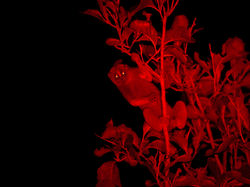
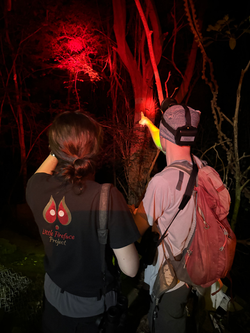
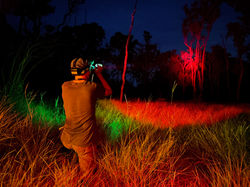
Currently, I am a PhD candidate at the University at Buffalo, supervised by Dr. Stephanie Poindexter and co-advised by Dr. Wendy Erb of the Yang Center. I work primarily at the Sakaerat Slow Loris Project in NE Thailand, with complementary work at the Endangered Primate Rescue Center in Vietnam, characterizing the vocal repertoire of Bengal slow lorises and the functions of their calls. I utilize passive acoustic monitoring (PAM) technology and attended ultrasonic recorders to uncover the diversity of their vocalizations, paying special attention to whether they are producing purely ultrasonic calls- something unknown for this species. Once I have a more robust catalogue of calls, I aim to perform surveys and density estimates for wild populations by utilizing PAM and AI technologies.
I provide regular talks to groups of Thai students at the Sakaerat Environmental Research Station about slow loris ecology and conservation, and I am beginning to work with local farmers to help them select trees that will be mutually beneficial for their livelihoods and support slow lorises by providing them with food and habitat.
 |  |  |  |
|---|---|---|---|
 |  |  |
MSc THAILAND
Khao Lak Merlin Resort
Phang Nga, Thailand
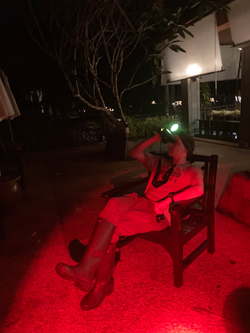
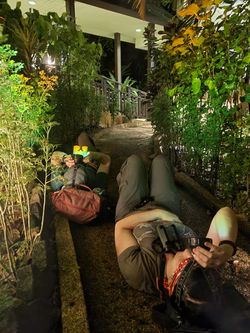
As part of my MSc, I am studying slow lorises in Thailand. Slow lorises (Nycticebus spp. & Xanthonycticebus pygmaeus) are a group of nocturnal and cryptic primates that live in South to Southeast Asia. Two species of slow loris are native to Thailand, the greater slow loris (N. coucang) and the Bengal slow loris (N. bengalensis), and they are both classified as Endangered by the IUCN and are understudied in Thailand.
I am examining the habitat use and behavioral repertoires of wild and native slow lorises and I will use the information from these data to assist the Love Wildlife Foundation to release rehabilitated slow lorises in Thailand. Additionally, I am monitoring ultrasonic calling behavior, canopy bridge use, and I am gauging species presence and human perceptions by surveying local people. Local ecological knowledge aids in our understanding of distribution and behavior, especially for underrepresented taxa for which data on distribution and conservation are lacking such as the slow lorises.
 |  |  |  |
|---|---|---|---|
 |  |
SOUTH AFRICA
Inkawu Vervet Project
KwaZulu-Natal, South Africa
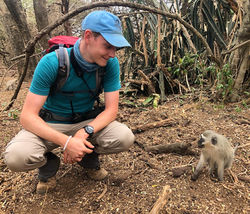
Vervet monkeys (Chlorocebus pygerythrus) are a prolific species of Old World monkey found throughout sub-Saharan Africa. The project is located on a private game reserve in KwaZulu-Natal, South Africa and hosts a number of local and international researchers. IVP provided me with the opportunity to assist graduate students and postdocs to perform playback experiments, fake predator experiments, and social learning experiments with several groups of wild vervet monkeys. I collected behavioral data via focal sampling, scan sampling, and ad libitum data collection as well as through fecal samples for genetics and eDNA.
The project is also partnered with a local vervet sanctuary, W.A.T.C.H., where I was able to participate in touchscreen cognition experiments with captive vervets as well as rehabilitation and reintroduction efforts for orphaned and injured vervet monkeys.
 |  |  |  |
|---|